


Happy 250th Birthday, America!
Spring 2026 Concert Notes
Tina Johns Heidrich, Conductor
Joe Jacovino, Accompanist
Connecticut Master Chorale Orchestra
Sunday March 15, 2026 3:00 pm
First Congregational Church, Danbury, Connecticut
- Concert Clips - Concert Photos -
These concert notes were prepared by soprano Ginnie Carey.
-

Linda Spevacek
b. 1945
Francis Bellamy
1855 - 1931The Pledge of Allegiance – Linda Spevacek; words by Francis Bellamy
The Pledge of Allegiance was written in August 1892 by Baptist minister Francis Bellamy, who had hoped that the pledge would be used by citizens in any country. First published in The Youth's Companion on September 8, 1892, the original text read "I pledge allegiance to my Flag and to the Republic for which it stands, one nation indivisible, with liberty and justice for all." In 1923, "my Flag" was changed to "the Flag of the United States of America" in order to specify which flag was being honored. The pledge was officially adopted by Congress in 1942. In 1954, responding to the Communist threat of the times, President Eisenhower encouraged Congress to add the words "under God," creating the 31-word pledge in use today.
-

Dan Forrest
b. 1978Folk Songs of America – arr. Dan Forrest
These notes were sourced from Dan Forrest's web site and edited for our use.
From acclaimed composer Dr. Dan Forrest comes the American Folksongs Series. He has created this choral cycle to fulfill a personal goal of bringing individual commissions together to participate in a larger narrative and build a sense of community. Folk Songs of America contains his new settings of American folk songs, representing distinctive facets of the richly diverse people and places found through various periods of American history, reaching the heart and soul through his formidable pairing of incisive writing and musical excellence.
-
1. How Firm a Foundation – American folk hymn
First published in A Compilation of Genuine Church Music in 1832 by Joseph Funk (1778 - 1862) with the hymn tune PROTECTION. The shape note system of musical notation, which made it easier for ordinary singers to learn to read music, first appeared in New England in 1801 and quickly became a popular teaching device as different variations spread, especially in the South. The text boldly asks, what stronger foundation can God give to His children who flee to him for protection, than the precious promises of His Word? Stanza after stanza then affirms these promises of protection and comfort, which helps to explain why it became one of the most influential hymns of the Civil War era.
Robert E. Lee requested that "How Firm a Foundation" be sung at his funeral, and it was also a favorite of Andrew Jackson and Theodore Roosevelt. Perhaps the most moving American historical idea, however, is the thought of the countless soldiers, fighting on both sides of the Civil War, who would have known this particular hymn and clung to its promises on the battlefield. This setting is inspired by that thought and therefore uses a musical style which evokes the 19th century American folk hymn tradition.
-

Samuel Medley
1738 - 17992. I Know That My Redeemer Lives – Francis C. Wood (1824 - 1872); words by Samuel Medley
Sometimes called "Shout On", this vigorous, energetic setting comes from another shape note collection, The Sacred Harp. First published in 1844 by Georgians B. F. White (1800 - 1879) and E. J. King (1821 - 1844), it is still in use today in singing communities that have spread from the American south to most of the United States, Europe, and Australia. The hymn tune is ANTIOCH, #277, and it was composed by F. C. Wood in 1850.
-
The inaugural pieces in Folk Songs of America are the Two Colonial Folksongs, commissioned by the Williamsburg Choral Guild for their 35th anniversary. "The Nightingale" and "The Girl I Left Behind Me" celebrate the common idea of a soldier in the Colonial/Revolutionary era, the Appalachian folk song tradition, and that most timeless of folk song subjects - love. It is a satisfying tribute to the musical heritage of America that choirs and audiences today can enjoy the same songs that early Americans did hundreds of years ago.
Most colonial music derives from the Old Lands - England, Ireland, Scotland - but even in this early era of American history, a New Land spirit was starting to form. The texts and tunes of both of these folk songs have ties to 17th century England, but were brought to the New Land, where a number of variants became quite popular. Both sing of a soldier - in the first, a "brave volunteer" whose fiddle enchants a fair lady, and in the second, a blustering soldier whose professions of love are rather belied by his jaunty fife tune and his tales of soldiering.
-
3. The Nightingale – Appalachian folk song
The Nightingale is an American variant of the English folk song, "The Bold Grenadier". Often called "One Morning in May", the haunting pentatonic tune was published in 80 Appalachian Folk Songs by Cecil Sharp (1859 - 1924) and Maud Karpeles (1885 - 1976). They were pivotal figures in the early 20th century English folk revival movement, who collaborated on extensive collecting trips from 1915 to 1919, most notably in the Appalachian Mountains, resulting in the preservation of hundreds of folk songs and dances.
-
4. The Girl I Left Behind Me – Colonial American folk song
The Girl I Left Behind Me is of debated origin (English or Irish). Some sources claim it was popular in the colonial era, while others argue that it only crossed the Atlantic after the Revolution. Either way, one can easily sense that its narrative style and light-hearted fife tune would be quite at home in colonial America. It is said to have often been played when soldiers went to war or a naval ship set sail.
-
-
5. Who Can Sail Without the Wind? – Upper Midwest folk song
Commissioned by the Hopkins (Minnesota) High School Concert Choir, this is the fourth piece in the Folksongs of America cycle. A Swedish language folk song and lullaby that originated in the Swedish speaking areas of modern-day Finland, it was well known among Swedish immigrants in the American upper Midwest and would have had particular meaning for Scandinavians singing about leaving their homeland, although the theme of the text is broadly applicable to other "partings" as well. The contours of the piano accompaniment suggest waves against a boat, while the haunting vocal melody floats above it.
-

Isaac Watts
1674 - 17486. When I Can Read My Title Clear – Traditional American melody – words by Isaac Watts
This melody is taken from Kentucky Harmony, published in 1817 by Ananias Davisson (1780 - 1857), the first shape note tune book to originate in the South. Expressing the longing for a clear understanding of one's place in God's plan and the promise of eternal life, the title refers to the future state of glory and recognition in heaven, where believers will fully understand their identity and relationship with God. The hymn suggests that this clear understanding will come only when the believer is in heaven, not while still on earth. Regarded as the "Godfather of English Hymnody", Isaac Watts is credited with some 750 hymns, many of them still commonly sung in churches today.
-

Thomas Hayes Bayly
1797 - 18397. Long, Long Ago – Thomas Hayes Bayly – 19th Century "parlor song"
A typical example of the early 19th century American "parlor song", with its simple, singable melody and nostalgic emphasis on separation and longing. This new setting preserves the wistful mood of the original song, but casts it in a more modern musical idiom. Thomas H. Bayly was an English poet, songwriter, dramatist and writer. Written in 1833 and originally called "The Long Ago", the title was changed by the editor Rufus Wilmot Griswold when it was finally published in 1843, posthumously, in a Philadelphia magazine, along with a collection of other songs and poems by Bayly. It was the most popular song in the United States in 1844 and has remained a favorite over the years, right into the twentieth century.
-
8. Skip to My Lou – Traditional American folk song
Skip to My Lou originated in the American frontier play-party in the 1800's. Square dancing was forbidden by frontier preachers, and its common instrument, the fiddle, was deemed "of the devil", so families instead held play -parties, with more "innocent" dancing and without instruments. This song would have been sung by paired partners, joining hands with other couples, skipping in a circle around one partner-less person. Eventually the center person chose a partner, the new partner-less person went to the center of the ring, and the song began again. Over 40 verses of text have been identified, with all sorts of regional variations. The poet Carl Sandburg, a biographer of President Abraham Lincoln, writes that "Skip-to-My-Lou" was a popular party game in Lincoln's youth in southern Indiana.
-
-

Aaron Copland
1900 - 1990Hoe-Down (from Rodeo) – Aaron Copland
One of the most respected composers of the 20th century, Copland incorporated popular musical forms into his compositions and created uniquely American classical music. His ballet Rodeo is a celebration of the Old West, and was commissioned by the Ballet Russe de Monte Carlo, a dance company that moved to the U. S. during World War II. They hired Agnes de Mille as their choreographer, and she talked a reluctant Copland into a collaboration that became famous in American dance and musical history. The ballet premiered in 1942 at the Metropolitan Opera House and received 22 curtain calls.
-

André Thomas
b. 1952I Hear America Singing – André Thomas
Dr. Thomas has distinguished himself as a composer, conductor, and author and has been described as "the master of Gospel music" because of his creative arrangements of traditional spirituals. After a long career teaching at Florida State University, he was Visiting Professor of Conducting and Interim Conductor of the Yale Camerata from 2020 to 2022, and had a special three -year relationship with the London Symphony Orchestra beginning in 2022, "expanding their canvas of musical styles" by featuring diverse artists and composers, such as Wynton Marsalis, and introducing Symphonic Southern Gospel to the LSO repertoire.
This composition, combining the spiritual "Walk Together, Children" with additional text by American poet Walt Whitman was conducted by the composer at the February 2012 President's Day Choral Festival Concert at the John F. Kennedy Center for the Performing Arts. In his notes about the experience he wrote, "As we sang and played "I Hear America Singing", I could feel not only the words of Walt Whitman and the slaves in that setting but that I was clearly transforming the jangling discords of our nation into a beautiful symphony of brotherhood!".
-

Samel A. Ward
1848 - 1903
Katharine Lee Bates
1859 - 1929
with HamletFrom Sea to Shining Sea – Samuel A. Ward; words by Katharine Lee Bates; arr. Maurice C. Whitney (1909 - 1984)
An arrangement based on "America the Beautiful", this work has often been called the national hymn of the United States. Of particular interest to us here in New England is the fact that the lyrics were written by Katharine Lee Bates, a native of Falmouth, MA, and a professor of English Literature at Wellesley College. She was inspired by the view from Pike's Peak and wrote the text down as soon as she returned to her hotel. Her poem was first published in 1895 and was sung to several other melodies before finally being set in 1910 to the New Jersey composer Samuel A. Ward's hymn "Materna".
-

George William
Warren
1828 - 1902
Daniel Crane
Roberts
1841 - 1907
Mary McDonald
b. 1956God of our Fathers – George William Warren; words by Daniel Crane Roberts; arr. Mary McDonald
Episcopal priest Daniel C. Roberts, a veteran of the Union Army with a deep interest in history, is known to have written only this single poem intended to commemorate the first Centennial of Independence Day in 1867. Organist and Choir Director George Warren of St. Thomas Episcopal Church in New York City composed the hymn tune NATIONAL HYMN as a setting for the poem, which has been used to celebrate many patriotic gatherings through the years.
-

Joseph Martin
b. 1959A Festive Call to Freedom – arr. Joseph Martin
A traditional Shaker hymn takes on fresh purpose when joined with this original patriotic text by Joseph Martin, a powerful choral arrangement that celebrates the gifts of freedom and liberty and lauds our "citizens brave and free". Recognized throughout the United States for his over 2500 choral compositions, both sacred and secular, his music has been heard in such diverse locations as Carnegie Hall in New York City, and the Mel Tillis Theatre in Branson, Missouri, and is used in worship services in churches across the United States and Canada. He continues to surprise audiences with the variety and scope of his compositions and arrangements.
-

Samuel Francis Smith
1808 - 1895
Dan Forrest
b. 1978My Country, 'Tis of Thee – words by Samuel Francis Smith; AMERICA from Thesaurus Musicus (1744); arr. Dan Forrest
A significant 18th century English anthology, published in London by J. Simpson, Thesaurus Musicus includes "God Save the Queen", the melody used for "My Country, 'Tis of Thee". With lyrics by Samuel F. Smith, an American Baptist minister, journalist and author, this song served as one of the de facto national anthems of the United States (along with songs like "Hail, Columbia") before the adoption of "The Star-Spangled Banner" as the official U.S. national anthem in 1931. Commissioned by the United States Air Force Academy Band, Dan Forrest's dramatic arrangement breathes new life into the time-honored patriotic hymn.
-

Greg Gilpin
b. 1969
Larry Clark
b. 1963Armed Forces - The Pride of America! – arr. Greg Gilpin; orchestration by Larry Clark
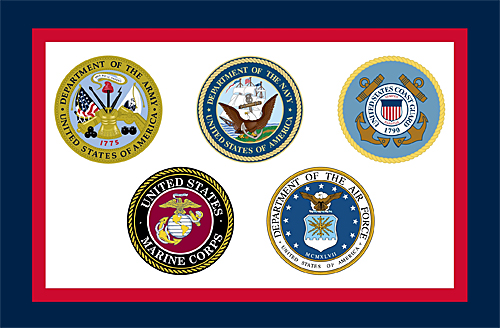
Greg Gilpin and Larry Clark have created the definitive patriotic American musical presentation with this medley of songs from five military branches and marches from John Philip Sousa and Edwin Eugene Bagley, culminating in our National Anthem.
- "The Caisson Song" (Army)
by Edmund L. Gruber -
"The Marine's Hymn" (Marines)
words by Henry C. Davis, music by Jacques Offenbach -
"Anchors Aweigh" (Navy)
by Capt. Alfred Hart Miles and Charles Zimmerman -
"Semper Paratus" (Coast Guard)
words and music by Captain Francis Saltus Van Boskerck -
"The U. S. Air Force" (Air Force)
by Robert Crawford -
"The Star Spangled Banner"
words by Francis Scott Key, music by John Stafford Smith - LAND OF THE FREE BECAUSE OF THE BRAVE!
- "The Caisson Song" (Army)