


Holiday Prelude Concert
~ Special Feature ~
An Eastern European Holiday
Fall 2026 Concert Notes
Tina Johns Heidrich, Conductor
Joe Jacovino, Accompanist
Connecticut Master Chorale Holiday Brass


Sunday November 22, 2026 3:00 pm
First Congregational Church, Danbury, Connecticut
- Concert Photos
- Recording Coming Soon
-
These concert notes were prepared by soprano Ginnie Carey.
-

Larry Shackley
b. 1956Rejoice! Christ Is Born! – Larry Shackley
Our program opens with a festive Christmas medley from composer, arranger and editor Larry Shackley. His lovely brass fanfare introduces Good Christian Friends Rejoice, with an 1853 translation by John M. Neale (1818 - 1866) of a text from a manuscript written in Leipzig in 1400. The hymn tune is IN DULCI JUBILO, originally a folk dance first published in 1535 in a German songbook. The Snow Lay on the Ground, is an Anglo-Irish carol from the 19th century, with a refrain in Latin that is also the hymn tune, VENITE ADOREMUS. O Come, All Ye Faithful, with music and Latin lyrics by John Frances Wade (1711 - 1786), was first printed in his 1751 collection Cantus Diversi. The hymn tune is ADESTE FIDELES, and the English translation was made in 1841 by Frederick Oakeley (1802 - 1880).
-

K. Lee Scott
b. 1950Rejoice, Rejoice, Believers – Laurentius Laurentii; arr. K. Lee Scott
Considered to be one of the finest hymn writers of his time, Laurentius Laurentii was the cantor and music director of the cathedral at Bremen, Germany. This 1700 hymn, like all of his works, is based on the Gospels, in this case the parable of the wise and foolish maidens waiting for the bridegroom with their lamps. The 1854 English translation is by Sarah B. Findlater (1823 - 1907). The hymn tune is a traditional Swedish folk melody, HAF TRONES LAMPA FӒRDIG, which translates as "keep your trimmed lamps ready". K. Lee Scott's triumphant arrangement features his impressive brass accompaniment.
-

Justin Thomas Fields
b. 1981A Babe Is Born in Bethlehem – Justin Thomas Fields
Puer Natus in Bethlehem is a traditional thirteenth century Latin Carol, translated in 1886 by Hamilton Montgomerie MacGill (1807 - 1880). A new composer for the Chorale, his a cappella arrangement takes us back in time, creating a deep sense of authenticity. Fields graduated summa cum laude from the Aaron Copland School of Music, and is a skilled pianist, organist, vocalist and director, in addition to his work as a composer.
-

Ola Gjeilo
b. 1978
Charles Anthony
Silvestri
b. 1965Seasons – Ola Gjeilo; words by Charles Anthony Silvestri
Norwegian composer and pianist Ola Gjeilo writes that he "was looking for a text that was timeless and could be performed any time of the year, and Tony created a beautiful poem about the unfoldment of each of the four seasons". This lovely, gentle and evocative work explores the unique qualities of the seasons with the deep sensitivity that we have come to expect from his compositions. He began his music education in Norway, has a Master's degree from the Julliard School and also studied at the Royal College of Music in London. He currently lives in Manhattan working as a freelance composer, as well as composer-in-residence with DCINY and Albany Pro Musica, and frequently performs his own works on piano.
-

Emily Crocker
b. 1949Pastores á Belén (Shepherds to Bethlehem) – arr. Emily Crocker
This traditional Spanish carol, or villancico, describes the journey of the shepherds to Bethlehem to see the newborn baby Jesus and the gifts that they bring Him. The original text is from 1612 and it has spread throughout the Spanish speaking world. This arrangement by Emily Crocker is based on a version from Puerto Rico and combines Jaime Peres's adaptation of the Spanish lyrics with her own English translation.
-

Robert Burns
1759 - 1796
Dan Forrest
b. 1978Auld Lang Syne – words by Robert Burns; arr. Dan Forrest
Burns sent the poem Auld Lang Syne to the Scots Musical Museum, indicating that it was an ancient song and he was the first to record it on paper. He adapted the old text and set it to this traditional Scottish tune. Dan Forrest's gorgeous arrangement brings new attention to the source of this song about looking back and preserving old friendships. Auld Lang Syne literally translates to "for old time's sake".
-

Jill Gallina
b. 1950Mi Y'malel – arr. Jill Gallina
Hanukkah, the Festival of Lights, celebrates Judas Maccabeus' victories and the rededication of the Temple of Jerusalem in 164 BCE. Mi Y'malel, or Who Can Retell? is based on Psalm 106:2 and is often sung as a round and performed as a circle dance. Jill Gallina's joyous arrangement celebrates the holiday in Hebrew and English.
-

Douglas E. Wagner
b. 1952Rejoice! (A Festive Carol Celebration) – arr. Douglas E. Wagner
An internationally recognized composer and arranger with graduate and undergraduate degrees in music, Douglas Wagner spent 30 years as a high school music educator and administrator. He now spends his time and energy composing and editing with great success. This brilliant medley features nine carols both individually and combined in clever counterpoint:
- O Come, All Ye Faithful, music and lyrics John Frances Wade (1711 - 1786), translated by Frederick Oakeley (1802 - 1880)
- O Come, Little Children, music by Johann Abraham Peter Schutz (1747 - 1800); words by Christoph von Schmid (1768 - 1854), translated by Herman H. Brueckner (1866 - 1942)
- Angels We Have Heard on High; a traditional French carol, English words by James Chadwick (1813 - 1882)
- Good King Wenceslas, music from the 1582 Latin song book Piae Cantiones, words by Jason Mason Neale (1818 - 1866)
- I Saw Three Ships, music is a traditional English folk song, 1833 words by William Sandys (1792 - 1874)
- Ukrainian Bell Carol, Mykola Leontovychin (1877 - 1921); words by Peter J. Wilhousky (1902 - 1978)
- God Rest Ye Merry, Gentlemen, a traditional English carol dating from the 1650s, 1833 words by William Sandys (1792 - 1874)
- Joy to the World; George Frideric Handel (1685 - 1759), arr. Lowell Mason (1792 - 1872), words by Isaac Watts (1674 - 1748)
- The First Noel, a traditional English carol with Cornish origins, first published in Carols Ancient and Modern, 1823
-

Stephen Hill
1956 - 2012
Daryl Williams

Mary McDonald
b. 1956Look Who Just Checked In – Stephen Hill and Daryl Williams; arr. Mary McDonald
Composer and arranger Mary McDonald's unique arrangement opens with lines from the spiritual Mary Had a Baby and cleverly weaves it into Gospel singer-songwriters Daryl Williams and Stephen Hill's high-energy favorite, proclaiming the news that the long-awaited baby has been born. We find out who just checked in with a memorable refrain "into the barn, into the world, into the hearts of the boys and girls. Never knew a baby quite like this, look who just checked in".
-
AN EASTERN EUROPEAN HOLIDAY
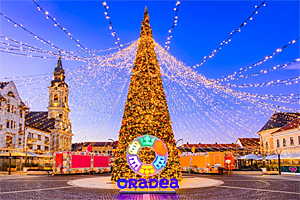
Oradea, Romania
-

Mark Burrows
b. 1971Kolyadá (Russia) – arr. Mark Burrows
Kolyadá is an ancient Slavic holiday the merges with Christmas and New Year, creating a unique atmosphere of celebration, joy and unity. The roots of the holiday go back to paganism and there are many theories about its precise origins. The word "Kolyadá" is associated with the Greek language and can mean "wheel", symbolizing the cycle of life, the change of seasons and the continuation of family. Originally celebrated on the winter solstice, it was a point of renewal and change, symbolizing the new cycle of life. There are many rituals and traditions, but the main element is caroling, when small groups of people or whole families go around to the houses of neighbors, singing songs of greeting, sometimes in costumes or traditional dress. Different Slavic countries and regions have their own unique customs, but the central aspect remains the same everywhere. Burrows' uplifting a cappella arrangement adds his own words in English.
-

Godfrey Tomanek
1925 - 2015Slovak Carol (Slovakia) – arr. Godfrey Tomanek
Tomanek was born in Chicago, but his family returned to "the old country", Wallachia, during the Depression. Slovakia was within walking distance of his home, and both peoples shared many things in common, including dialects, songs, folk art and religious customs, all of which had a profound influence on him. Musically talented from a young age, he became a church organist at 16. When he returned to America in 1949, he was already an established musician. Tomanek was a noted conductor, composer, organist, teacher, and piano technician, and served as organist/choir master in numerous churches in the Midwest and Connecticut. He also led choirs in over 500 concerts in the Northeast and gave recitals in many parts of the world. He arranged and translated this lovely traditional carol.
-

Alexandru Paşcanu
1920 - 1989Chindia (Romania) – Alexandru Paşcanu
Pronounced "keen-DEE-ah", this is perhaps Pascanu's most famous composition. Based on an instrumental Romanian folk dance of the same name, it refers both to the time of day just before the sun sets and to the place in the sky where the sun goes down. The dance is performed by both men and women in a closed circle, with the dancers' arms on each other's shoulders. There are no words in this song, only Pascanu's imaginative use of descriptive monosyllables. A member of the faculty of the Music Conservatory in Bucharest., he composed choral, orchestral and chamber music.
-

James Knox
b. 1970
Peter J. Wilhousky
1902 - 1978
Mykola Leontovychin
1877 - 1921Carol of the Bells (Bountiful Evening) (Ukraine) – Mykola Leontovychin; words by Peter J. Wilhousky; arr. James Knox
Shchedryk (Bountiful Evening) is a Ukrainian song of celebration, sung on New Year's Eve, which tells of a swallow flying into a house at New Year to sing of the wealth that will come with the following spring. The folk song was composed and arranged by the Ukrainian Priest and composer Mykola Leontovychin between 1901 and 1919. American composer and educator Peter J. Wilhousky, who was deeply involved in the Ukrainian culture and music of his parents, transformed it into a Christmas carol. With a BA degree from what is now the Julliard School, he worked as a high school music teacher in Brooklyn with great success, and his student choirs performed yearly at Carnegie Hall and Lincoln Center. He was also a music arranger for the NBC Radio Symphony Orchestra. Following a performance in October 1922, Wilhousky wrote his own new lyrics for the melody and created Carol of the Bells. James Knox's arrangement combines Wilhousky's carol with Bountiful Evening to complete the creative cycle.
-
-

Pinkzebra
December in My Hometown – Pinkzebra
This nostalgic ballad is a sentimental tribute to everyone who looks back with fond memories at the beauty and the special kind of spirit found only at Christmastime in their hometown. Pinkzebra is the pseudonym of a successful music producer and composer. In his career he has been signed by a major record label, composed and produced music for television and film, had his music performed by major symphony orchestras, and written music for hundreds of award-winning commercials. He loves listening to other people perform his music and appreciates that others are bringing his music to life in a way that connects and inspires.
-

Greg Gilpin
b. 1969
James Lord Pierpont
1822 - 1893A One-Horse Open Sleigh (In a Jingly Minor Way) – Greg Gilpin; words by James Lord Pierpont
Composer Greg Gilpin has created a new vision of the classic Jingle Bells, setting the lyrics to a jingly minor version of the familiar melody. In 1832, at the age of ten, lyricist James Lord Pierpont left his Boston home for a boarding school in New Hampshire. The son of a strict Unitarian minister, James wrote to his mother about how much he enjoyed a sleigh ride through the beautiful countryside. That vision, and his fondness for the sleigh races in Medford, Massachusetts, where he lived as a young man, are credited as the inspiration for Jingle Bells. Sleighing songs were a popular genre at the time, and it was first printed as The One Horse Open Sleigh in 1857. Republished two years later as Jingle Bells, it only became a Christmas holiday favorite in the early 1900s. It was the first song broadcast from space during the Gemini 6 mission in 1965 and has become one of the most performed holiday songs in the world.
-

Mindy Smith
b. 1972
Chely Wright
b. 1970
Mark Hayes
b. 1953Santa Will Find You – Mindy Smith and Chely Wright; arr. Mark Hayes
Filled with memories of childhood innocence and Christmas wonder, and intended to comfort families who can't be together for Christmas, this song is a tribute to the many people who are alone for the holidays. The emotions include loneliness, hope, and comfort. Offering a promise of being found and remembered, even when physically apart, the lyrics "You'll never be lost if you truly believe in your heart" express the central message that belief in love and connection can overcome distance and "Santa can find you wherever you are".
-

Henry Sanicola 1914 - 1974
Frank Sinatra 1915 - 1998
Dok Stanford
1917 - 1967
Mark Hayes
b. 1953Mistletoe and Holly – Frank Sinatra, Dok Stanford, and Henry Sanicola; arr. Mark Hayes
This Christmas song was written by Frank Sinatra with his longtime associates Hank Sanicola and Dok Stanford in 1957 for his holiday album "A Jolly Christmas from Frank Sinatra", released by Capitol Records. Recorded by Sinatra with The Ralph Brewster Singers and an orchestra conducted by Gordon Jenkins, the album became one of the best-selling Christmas albums in American history, and Mistletoe and Holly remains one of its most enduring tracks. Billboard magazine commented "Sinatra gives this one a crisp and polished vocal to a tasteful backing". The album reached the top of the Billboard charts and has remained a holiday staple for decades, cementing Sinatra's status as a definitive voice of the American Christmas tradition. Mark Hayes has written a great nostalgic swing arrangement for chorus and big band.
-

Sheri Easter
b. 1963
Mike Speck
b. 1954
Lari Goss
1945 - 2015
Danny Zaloudik
b. 1956Something to Shout About! – Sheri Easter; arr. Mike Speck, Lari Goss and Danny Zaloudik
The title says it all! Incorporating "Go Tell it on the Mountain", this inspiring and exhilarating gospel finale from the musical Christmas is Jesus will have everyone clapping and dancing in the aisles!