


CREATION
by Dan Forrest
Spring 2027 Concert Notes
Tina Johns Heidrich, Conductor
Joseph Jacovino, Jr., Accompanist
Louise Fauteux, Soprano
Connecticut Master Chorale Orchestra
Sunday April 04, 2027 - 3:00 pm
First Congregational Church, Danbury, Connecticut
- Soloist - Tickets Available Soon - Directions -
These concert notes were sourced from the website of Dan Forrest..
Dan Forrest unfolds a spectacularly sweeping score in CREATION, his newest and most expansive work to date. Written on the 225th anniversary of Haydn's similarly-themed masterpiece, this oratorio explores the wonders of our planet through a dazzling variety of musical expressions. Reviews have hailed its "cinematic quality", calling it Dan's "most sophisticated composition to date", "the most joyful, exuberant piece of music I've ever run across", and described it as "a thrill!".

Dan Forrest
b. 1978
- Introit ushers the listener into a mysterious world before the dawn of time, as chants of Veni, Creator Spiritus arise and are mixed with the introduction of key musical themes for the entire work.
- The Dance Before Time begins without pause, with the "spirit moving upon the face of the waters." A Soprano solo begins the narrative, "in principio Deus," amidst swirls of themes from this movement and the previous one, and creative energy builds, waiting to be unleashed.
- The Lion Sings alludes to a well-known Lion in famous English children's literature, who sang a world into existence. A well-read listener will hear every musical detail from that story happening, from the tenors and basses singing the Lion's song, to the sun bursting into light, the unfurling of all green things, and eventually all animals coming to life in a raucous barndance celebrating the joy of all creation.
- Light, inspired by countless sunrises, sets "I am the light of the world; who follows me shall have the light of life" as an exuberant dance in asymmetrical meter. The initial melody from the Introit then returns as a coda with new text combining "…and God saw that it was good" from Genesis with words from the Song of Solomon - a love song to an unspoiled creation: "wholly beautiful are you, entirely, and there is no stain in you." This refrain is then heard after each day of creation, transformed into that movement's unique musical style.
- Sky is inspired by the expanse of the open sky. As the first tribute to Haydn, melodic themes from his The Heavens Are Telling are interwoven (in slow motion) with modern harmonization and new material throughout this movement.
- The Garden is an expression of the composer's love of various gardens in the world, from New York (Central Park) to Singapore (Botanical Gardens) to his own #forrestgardens. This setting reimagines the meaning of sacred texts to express the priceless beauty of green spaces; the Locus Iste here refers not to a cathedral, but to the sacred sanctuary of a garden. The music slowly twines around itself, almost like time-lapse photography of plants unfolding shoots and leaves.
- Music of the Spheres invokes the concept of "musica universalis"- the "music of the heavens" that the ancients believed was created by the orderly and proportional motion of the stars and planets in space, as well as "vox caelestis" - the "voice of the heavens" that speaks in the night sky. The Sanctus text is set here as a four-part mensuration canon, where each melodic subject entrance is twice as slow as the previous one; eventually we hear the same melodic line at four different speeds simultaneously, picturing the clock-like precision of the stars and planets moving through space.
- Wings represents the "flying creatures" portion of day five, with text from the Psalms. The music begins delicately, like a newly hatched butterfly first unfolding its wings and fanning them, then gradually builds to the moment where it bursts into flight and is carried on the wind until it disappears from sight. The main melodic ostinato in the accompaniment of this movement is an example of augenmusik - music for the eyes- where the musical page looks like the ideas being described: its instrumental melodic contour outlines the line-drawn shape of a bird in flight.
- Deep Blue then turns to the "deep sea" portion of day five, with liturgical text "I saw water flowing…". The mysteries of the deep are invoked with low thick textures and constantly flowing water and waves. Eventually, "Alleluias" arise from the depths, like a whale breaching the surface of the ocean.
- Ish Ishah was inspired by Michelangelo's famous painting The Creation of Adam. Its finger of God reaching to humanity was quite possibly inspired by the Veni Creator Spiritus text (heard earlier in this work), in the stanza sung here: "Finger of God's right hand…kindle your light in our minds, infuse love in our hearts." Many believe that the primary character visible on God's arm in the painting is Eve; her face as she strains for a look at Adam reflects the first stirring of human love, with all its wonder and complexity - the moment God "infuses love into our hearts." The Hebrew words Ish Ishah are taken from the Genesis narrative, representing man and woman, and this setting presents humanity as the pinnacle of all creation, not merely in their intellect or the beauty of their form, but in their capacity to love.
- Boundless unleashes a torrent of musical themes, all piling on top of each other, in a finale celebrating the diversity yet wholeness of all creation. The title refers both to the limitless joy found within the movement as well as the seemingly limitless number of themes (from within this work and beyond) which all tumble together. Amidst all this celebration, a fugue breaks out. Marked "Homage to FJH", it uses thematic material from this work's Credo within the formal and harmonic structure of Haydn's beloved Awake the Harp. Eventually all possible themes and subjects are recapitulated in a celebration whose joy can only be described as boundless.
We then encounter several tableaus representing the days of creation; each sets a Scriptural or liturgical text as commentary on the beauty of that part of creation, inspired by various experiences from the composer's travels.

Forrest Gardens
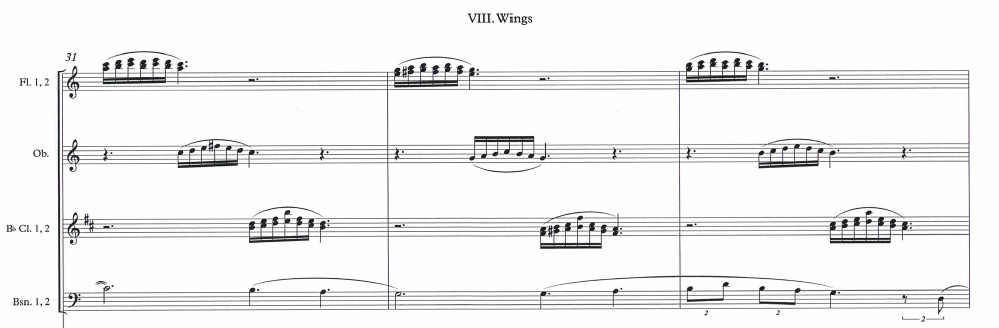
Example of Augenmusik from the score of Wings
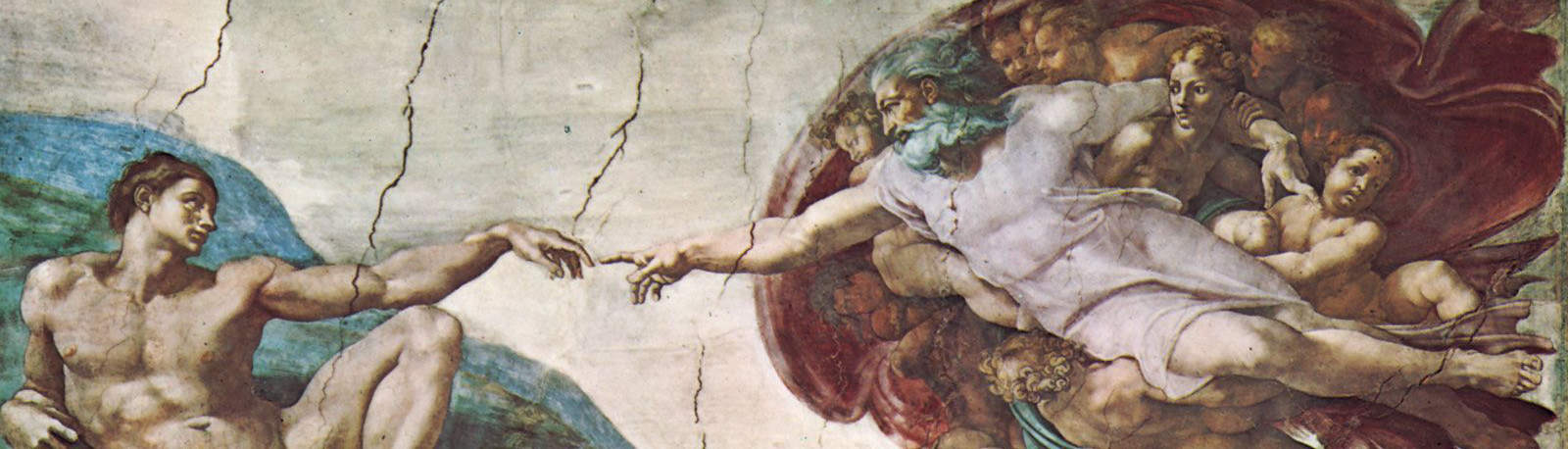
The Creation of Adam - Sistine Chapel, Vatican